


Part 1 · Daniel 2: The Rise and Fall of World Empires
Part 1 of 3 · Daniel and Revelation

More than twenty-five centuries ago, in the royal palace of Babylon, the God of heaven gave King Nebuchadnezzar a panoramic vision of world history stretching from his own throne to the Second Coming of Jesus Christ. Recorded in the second chapter of Daniel, this foundational prophecy establishes the historicist key to all apocalyptic Scripture and proves beyond a shadow of doubt that our times are in the hand of an all-knowing God.
I. The Forgotten Dream & The God Who Reveals Secrets
What unique credential does the God of the Bible claim as proof of His supreme divinity?
Verse: “Remember the former things of old: for I am God, and there is none else; I am God, and there is none like me, Declaring the end from the beginning, and from ancient times the things that are not yet done, saying, My counsel shall stand, and I will do all my pleasure:” (Isaiah 46:9–10, KJV; see also 2 Peter 1:19)
Explanation: Human historians can only record events after they have occurred, and human predictors guess blindly at tomorrow. The Creator alone declares “the end from the beginning,” outlining centuries of empire building and collapse before a single event takes place.
When Babylon’s astrologers and magicians failed to recall Nebuchadnezzar’s forgotten dream, to whom did Daniel give all glory?
Verse: “Daniel answered in the presence of the king, and said, The secret which the king hath demanded cannot the wise men, the astrologers, the magicians, the soothsayers, shew unto the king; But there is a God in heaven that revealeth secrets, and maketh known to the king Nebuchadnezzar what shall be in the latter days.” (Daniel 2:27–28, KJV)
Explanation: God permitted the king to forget the dream so that Babylon’s occult wise men could not invent a flattering interpretation. After Daniel and his three faithful companions—Hananiah, Mishael, and Azariah—united in earnest prayer (Daniel 2:17–19), God revealed both the dream and its meaning, directing Nebuchadnezzar’s gaze to “what shall be in the latter days.”
What awesome object did the king behold in his night vision?
Verse: “Thou, O king, sawest, and behold a great image. This great image, whose brightness was excellent, stood before thee; and the form thereof was terrible. This image's head was of fine gold, his breast and his arms of silver, his belly and his thighs of brass, His legs of iron, his feet part of iron and part of clay.” (Daniel 2:31–33, KJV)
Explanation: Nebuchadnezzar beheld a towering metallic statue composed of four successive metals of decreasing value but increasing hardness—gold, silver, brass (bronze), and iron—terminating in feet and toes of iron mingled with miry clay.
II. The Four Universal Empires of History
What empire was represented by the head of fine gold?
Verse: “Thou, O king, art a king of kings: for the God of heaven hath given thee a kingdom, power, and strength, and glory. And wheresoever the children of men dwell, the beasts of the field and the fowls of the heaven hath he given into thine hand, and hath made thee ruler over them all. Thou art this head of gold.” (Daniel 2:37–38, KJV)
Explanation: Inspiration leaves nothing to guesswork: the head of gold represented the Neo-Babylonian Empire (605–539 B.C.), unmatched in ancient wealth and architectural splendor, whose chief temple and royal throne were lavished with pure gold.
Did Babylon last forever as Nebuchadnezzar hoped, and what two empires followed it?
Verse: “And after thee shall arise another kingdom inferior to thee, and another third kingdom of brass, which shall bear rule over all the earth.” (Daniel 2:39, KJV)
Explanation: On the very night of Belshazzar’s impious feast in 539 B.C. (Daniel 5:28–31), Babylon fell to the dual empire of the Medes and Persians (539–331 B.C.), symbolized by the breast and two arms of silver. Medo-Persia was in turn conquered by Alexander the Great and the Grecians (331–168 B.C.), the “third kingdom of brass,” whose bronze-armored soldiers bore rule across the ancient world.
How did Daniel describe the fourth empire, represented by the two legs of iron?
Verse: “And the fourth kingdom shall be strong as iron: forasmuch as iron breaketh in pieces and subdueth all things: and as iron that breaketh all these, shall it break in pieces and bruise.” (Daniel 2:40, KJV)
Explanation: The iron monarchy of Rome (168 B.C. – A.D. 476) crushed every rival power around the Mediterranean basin with iron discipline. It was under Roman rule that Jesus Christ was born (Luke 2:1) and crucified by a Roman governor.
III. Divided Europe & The Stone Cut Out Without Hands
Would a fifth universal human empire arise after Rome, or what would happen to the iron kingdom?
Verse: “And whereas thou sawest the feet and toes, part of potters' clay, and part of iron, the kingdom shall be divided; but there shall be in it of the strength of the iron, forasmuch as thou sawest the iron mixed with miry clay. And as the toes of the feet were part of iron, and part of clay, so the kingdom shall be partly strong, and partly broken.” (Daniel 2:41–42, KJV)
Explanation: Instead of being overthrown by a fifth world empire, the Western Roman Empire fractured between A.D. 351 and A.D. 476 into the divided kingdoms of Europe—represented by the feet and toes of iron mixed with clay (corresponding to the ten horns of Daniel 7:24). Down to this very day, we live in the era of the feet and toes.
In what seven explicit words did God foretell the failure of every human effort to reunite Europe into one lasting empire?
Verse: “And whereas thou sawest iron mixed with miry clay, they shall mingle themselves with the seed of men: but they shall not cleave one to another, even as iron is not mixed with clay.” (Daniel 2:43, KJV)
Explanation: Through royal intermarriages (“they shall mingle themselves with the seed of men”), treaties, and military conquests—from Charlemagne and Charles V to Napoleon, Kaiser Wilhelm, and Hitler—ambitious rulers have tried to weld Europe back into a single empire. Every attempt has shattered against seven divine words: “they shall not cleave one to another.”
What climactic event brings an end to all earthly kingdoms in the dream?
Verse: “Thou sawest till that a stone was cut out without hands, which smote the image upon his feet that were of iron and clay, and brake them to pieces. Then was the iron, the clay, the brass, the silver, and the gold, broken to pieces together, and became like the chaff of the summer threshingfloors; and the wind carried them away, that no place was found for them: and the stone that smote the image became a great mountain, and filled the whole earth.” (Daniel 2:34–35, KJV)
Explanation: Notice where the Stone strikes the image: not upon the legs of pagan Rome (proving that the Stone kingdom is not the first-century church), nor through gradual human politics (“cut out without hands”), but squarely upon the feet of iron and clay at the end of time, sweeping away every trace of earthly dominion.
Who sets up this everlasting kingdom, and when is it established?
Verse: “And in the days of these kings shall the God of heaven set up a kingdom, which shall never be destroyed: and the kingdom shall not be left to other people, but it shall break in pieces and consume all these kingdoms, and it shall stand for ever.” (Daniel 2:44, KJV)
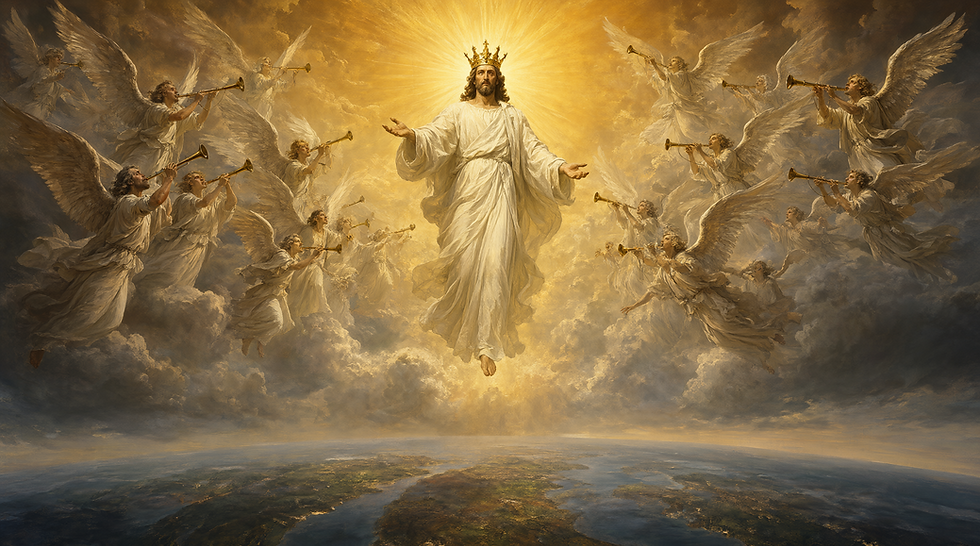
Explanation: “In the days of these kings”—while the nations of divided Europe still exist—the God of heaven Himself establishes His eternal kingdom at the glorious Second Coming of Jesus Christ, the Rock of Ages (Matthew 21:44; 25:31–34; Revelation 11:15).
With what triumphant assurance did Daniel close his interpretation before the king?
Verse: “Forasmuch as thou sawest that the stone was cut out of the mountain without hands, and that it brake in pieces the iron, the brass, the clay, the silver, and the gold; the great God hath made known to the king what shall come to pass hereafter: and the dream is certain, and the interpretation thereof sure.” (Daniel 2:45, KJV)
Explanation: Babylon rose and fell on schedule. Medo-Persia rose and fell on schedule. Greece and pagan Rome rose and fell on schedule. Divided Europe has remained divided for over fifteen hundred years, exactly as foretold. The final scene—the coming of Christ’s everlasting kingdom—is just as certain and sure!
Conclusion & Personal Appeal
Every metal of Nebuchadnezzar’s image has passed into history except the feet and toes upon which we now stand. The next universal kingdom will be the everlasting kingdom of our Lord and Saviour Jesus Christ. Surrender your life today to the Rock of Ages, so that when earthly empires pass away like chaff, you will stand forever in the kingdom that shall never be destroyed!
Related reading: The Manner & Certainty of Christ’s Second Coming: A Comprehensive Biblical Study · The Three Angels’ Messages of Revelation 14: God’s Final Warning & Mercy to the World · The Millennium of Revelation 20 & The Earth Made New: A Comprehensive Biblical Study
Continue the course: All parts of Daniel and Revelation


Comments