


Part 3 · Revelation 14: The Three Angels' Messages
Updated: 4 days ago
Part 3 of 3 · Daniel and Revelation

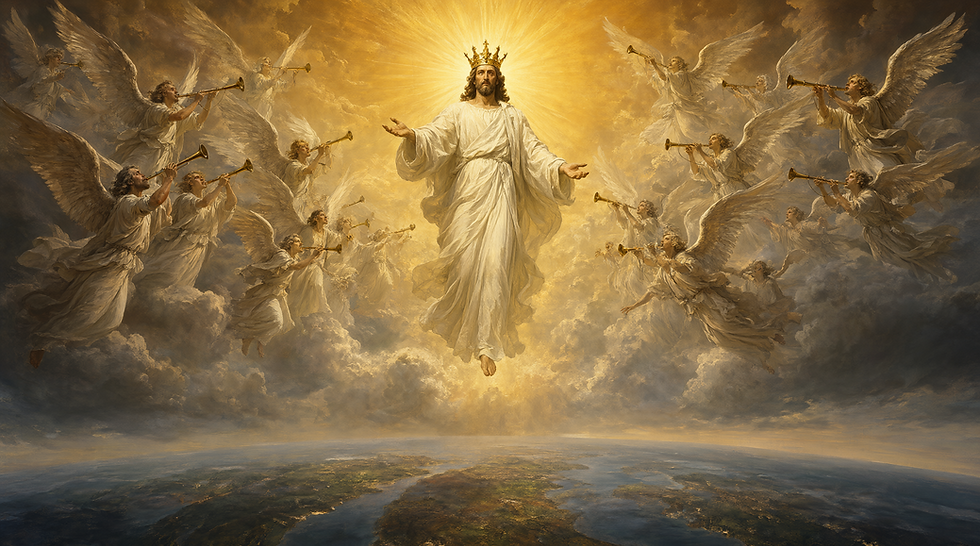
Immediately before the vision of Christ’s glorious return on the white cloud to reap the harvest of the earth (Revelation 14:14), the apostle John beheld three angels flying in the midst of heaven with a threefold proclamation for every nation, kindred, tongue, and people. Far from being dry symbols, the Three Angels’ Messages of Revelation 14:6–12 are heaven’s final call of mercy, uniting the everlasting gospel of Christ’s cross with His closing ministry in the heavenly sanctuary.
I. The First Angel’s Message: The Everlasting Gospel & The Hour of God’s Judgment
What is the foundation of the Three Angels’ Messages, and to whom is it proclaimed?
Verse: “And I saw another angel fly in the midst of heaven, having the everlasting gospel to preach unto them that dwell on the earth, and to every nation, and kindred, and tongue, and people,” (Revelation 14:6, KJV)
Explanation: Before a single word of judgment or warning is spoken, heaven places the “everlasting gospel” at the very forefront. There is only one gospel from Eden to the New Jerusalem—salvation through the atoning blood, victorious resurrection, and High Priestly ministry of Jesus Christ—and this message must go to every nation, kindred, tongue, and people before the end comes (Matthew 24:14).
Why does the Bible call the gospel of Jesus Christ “the power of God unto salvation”?
Verse: “For I am not ashamed of the gospel of Christ: for it is the power of God unto salvation to every one that believeth; to the Jew first, and also to the Greek.” (Romans 1:16, KJV)
Explanation: The everlasting gospel is not merely pardon for past sins; it is divine power that both forgives the repentant sinner through justification and transforms the heart in sanctification, restoring the image of God in the soul.
What urgent fourfold call does the First Angel proclaim with a loud voice?
Verse: “Saying with a loud voice, Fear God, and give glory to him; for the hour of his judgment is come: and worship him that made heaven, and earth, and the sea, and the fountains of waters.” (Revelation 14:7, KJV)
Explanation: The First Angel calls humanity to four vital duties in light of the closing sanctuary ministry: (1) “Fear God”—reverence Him with supreme loyalty; (2) “Give glory to him”—reveal His character in our body, mind, and daily conduct (1 Corinthians 10:31); (3) recognize that “the hour of his judgment is come”—the pre-Advent investigative judgment in heaven that began at the close of the 2300-day prophecy in 1844 (Daniel 7:9–10; 8:14); and (4) “Worship him that made heaven, and earth, and the sea, and the fountains of waters.”
By what unchangeable standard are all human lives examined in the judgment?
Verse: “Let us hear the conclusion of the whole matter: Fear God, and keep his commandments: for this is the whole duty of man. For God shall bring every work into judgment, with every secret thing, whether it be good, or whether it be evil.” (Ecclesiastes 12:13–14, KJV; see also James 2:12)
Explanation: In the heavenly courtroom, God’s moral law of Ten Commandments—stored inside the Ark of the Covenant beneath the Mercy Seat (Revelation 11:19)—is the standard of judgment, while Jesus stands as our Advocate to plead His blood for every believer whose faith works by love.
Which commandment of God’s law did the First Angel directly quote when calling the world to worship the Creator?
Verse: “Remember the sabbath day, to keep it holy... For in six days the LORD made heaven and earth, the sea, and all that in them is, and rested the seventh day: wherefore the LORD blessed the sabbath day, and hallowed it.” (Exodus 20:8, 11, KJV)
Explanation: Notice the unmistakable verbal link: the First Angel’s call to “worship him that made heaven, and earth, and the sea” (Revelation 14:7) quotes directly from the fourth commandment of the Decalogue (Exodus 20:11). In an age of widespread evolutionary skepticism and human tradition, God calls the world back to the seventh-day Sabbath—the eternal memorial of His creative power.
II. The Second & Third Angels’ Messages: Spiritual Babylon vs. The Seal of the Living God
What solemn announcement does the Second Angel make concerning spiritual Babylon?
Verse: “And there followed another angel, saying, Babylon is fallen, is fallen, that great city, because she made all nations drink of the wine of the wrath of her fornication.” (Revelation 14:8, KJV)
Explanation: In Bible prophecy, a pure woman represents God’s faithful church (Jeremiah 6:2; 2 Corinthians 11:2), whereas an unfaithful woman—“Babylon”—represents apostate religious systems that have forsaken the plain truths of Scripture to unite with worldly power. The “wine of Babylon” represents her false, unbiblical doctrines—such as replacing God’s seventh-day Sabbath with Sunday and teaching the natural immortality of the soul—which intoxicate the nations and obscure Christ’s true priesthood.
Why does God mercifully expose Babylon’s fall, and what loving call does He send to His sincere children still inside her?
Verse: “And I heard another voice from heaven, saying, Come out of her, my people, that ye be not partakers of her sins, and that ye receive not of her plagues.” (Revelation 18:4, KJV)
Explanation: God has multitudes of sincere, devoted followers currently scattered throughout the religious bodies of spiritual Babylon who have not yet seen the full light of His truth. The message of Babylon’s fall is not given in harshness, but in tender mercy to call Christ’s sheep out of human tradition and into the safety of His commandment-keeping fold before the final plagues fall.
Against what supreme deception and counterfeit worship does the Third Angel warn the world?
Verse: “And the third angel followed them, saying with a loud voice, If any man worship the beast and his image, and receive his mark in his forehead, or in his hand, The same shall drink of the wine of the wrath of God, which is poured out without mixture into the cup of his indignation; and he shall be tormented with fire and brimstone in the presence of the holy angels, and in the presence of the Lamb:” (Revelation 14:9–10, KJV)
Explanation: The final conflict of the Great Controversy centers on worship and authority: will we obey the Creator and keep His commandments, or yield allegiance to the beast power (Daniel 7:25; Revelation 13) by accepting its counterfeit mark of authority enforced by civil law? Receiving the mark in the “forehead” represents a settled conviction of the mind, while receiving it in the “hand” represents outward compliance for worldly convenience despite knowing the truth.
What divine sign does God place upon the foreheads of His faithful servants before the winds of strife are loosed?
Verse: “Saying, Hurt not the earth, neither the sea, nor the trees, till we have sealed the servants of our God in their foreheads.” (Revelation 7:3, KJV; see also Ezekiel 20:20: “And hallow my sabbaths; and they shall be a sign between me and you, that ye may know that I am the LORD your God.”)
Explanation: In contrast to the beast’s counterfeit mark, the seal of the living God is placed solely in the forehead—symbolizing a settled, heart-deep loyalty to Christ and His truth so firm that nothing can move it. In Scripture, God explicitly identifies His seventh-day Sabbath as the sign (or seal) between Himself and His sanctified people (Exodus 31:13, 17; Ezekiel 20:12, 20), containing His name, His title as Creator, and His territory (Exodus 20:8–11).
III. The Remnant People of Prophecy & The Harvest of the Earth
How does the Third Angel describe the character of God’s faithful remnant people who triumph in the final crisis?
Verse: “Here is the patience of the saints: here are they that keep the commandments of God, and the faith of Jesus.” (Revelation 14:12, KJV)
Explanation: God’s end-time remnant does not trust in human merit or legalism, nor do they cast aside God’s law. They unite both pillars of the everlasting covenant: they “keep the commandments of God”—including the fourth commandment Sabbath—through “the faith of Jesus,” relying wholly upon His indwelling grace, His atoning blood, and His victorious power.
What glorious event immediately follows the proclamation of the Three Angels’ Messages?
Verse: “And I looked, and behold a white cloud, and upon the cloud one sat like unto the Son of man, having on his head a golden crown, and in his hand a sharp sickle. And another angel came out of the temple, crying with a loud voice to him that sat on the cloud, Thrust in thy sickle, and reap: for the time is come for thee to reap; for the harvest of the earth is ripe.” (Revelation 14:14–15, KJV)
Explanation: When the Three Angels’ Messages have accomplished their work in every nation and every soul has made a final decision for Christ or for Babylon, Jesus lays aside His priestly garments, puts on His golden crown as King of kings, and descends upon the white cloud to gather His redeemed harvest home forever.
Conclusion & Personal Appeal
Today heaven’s final call of mercy rings out to every heart: “Fear God, and give glory to him; for the hour of his judgment is come: and worship him that made heaven, and earth, and the sea, and the fountains of waters.” Step out of every human tradition, surrender your heart to Jesus, and stand among those who keep the commandments of God and the faith of Jesus!
Related reading: The Sabbath and God’s Enduring Law: A Comprehensive Biblical Study · The Heavenly Sanctuary & Christ’s High Priestly Ministry: A Comprehensive Biblical Study · The Manner & Certainty of Christ’s Second Coming: A Comprehensive Biblical Study
Continue the course: All parts of Daniel and Revelation


Comments